Who at High School Teaches AI Skills?
A few weeks ago I was invited to speak to the Ballina Careers Advisers Group about artificial intelligence. I expected the usual questions: is it safe, is it accurate, and how to use it in career advice. Those concerns are real, but by the end of the session one question felt far more important than all the others.
Who, exactly, is going to teach our students how to use AI?
Because students are already using it. Not occasionally. Daily, without anyone guiding them. The debate about whether students should use AI has effectively passed. The real issue now is whether they learn to use it wisely, responsibly and in ways that genuinely improve their future.
The challenge for schools is that AI has no obvious home.
It isn’t a subject, yet it influences every subject. It doesn’t sit neatly inside English, Maths or Science, but it will shape how students research, draft, revise, plan, compare options and solve problems across all of them. When something affects everything but is owned by no one, students don’t get trained, they simply experiment. Some will do that well. Many won’t. And a lot will develop habits that look productive in the moment but leave them underprepared for real work.
Employers will ask about AI experience and capabilities.
In employment, AI is rapidly shifting from a “nice to have” to an expectation. Recruiters and employers are already starting to ask applicants about their capability with AI tools. Very soon, it will be as normal as asking about teamwork, communication or digital skills. The question won’t simply be “Do you use AI?” It will be more revealing: when do you use it, why do you use it, and what judgement do you apply before relying on what it produces?
In other words, students will be assessed on whether they can use AI with maturity.
A strong candidate won’t sound defensive about AI. They’ll sound deliberate. They’ll be able to explain that AI helps them organise information, speed up early drafts, and improve clarity, but that they remain accountable for the final output. They’ll describe how they check for accuracy, assumptions and confidentiality. They’ll show they understand the difference between using AI as a tool and outsourcing thinking altogether. That is what workplace readiness will look like. And it will be reflected in résumés and LinkedIn profiles, not as a gimmick, but as evidence of capability.
So where does that leave schools?
It leaves them with a simple responsibility: if AI competence will be judged in employment, then AI literacy must be taught before students leave school. Not as a technical deep-dive, but as practical life training: how to ask better questions, how to evaluate answers, how to verify and cross-check, how to protect privacy, and how to use AI to produce better work without compromising integrity.
And this is where I believe Career Advisers are uniquely positioned to lead.
In most schools, academic teachers are rightly focused on curriculum outcomes within their disciplines. They are not resourced or expected to take ownership of AI as a whole-school capability. Career Advisers, however, already work across the entire student. They sit at the intersection of subject choice, career direction, study pathways, employability skills and wellbeing. They deal in future readiness. They understand that success after school isn’t just about knowledge, it’s about decision-making, confidence, planning and persistence.
In an age of AI, the Careers Adviser’s role does not diminish. It evolves.
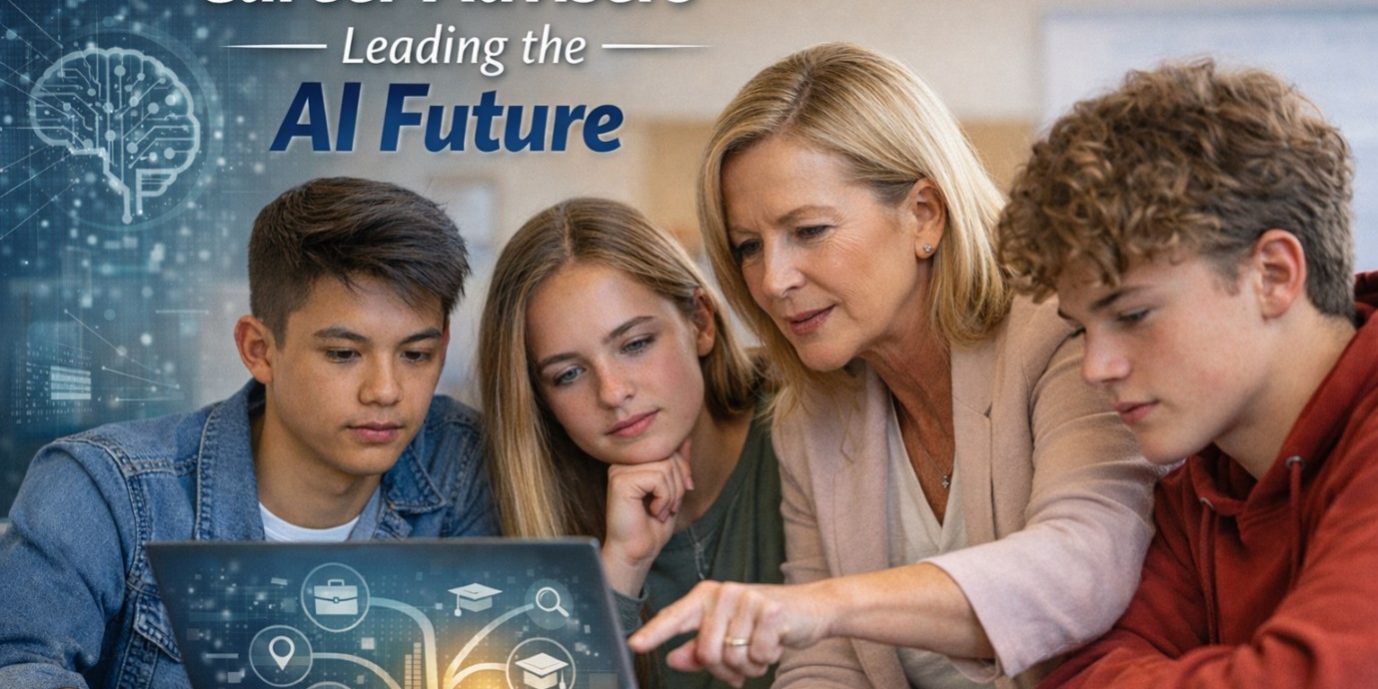
What Career Advisers can do is become the school’s “AI mentor” — the person who helps students use AI for career discovery, subject planning and study choices in a way that is personal, grounded and safe. That leadership doesn’t require advisers to become technical experts. It requires them to become confident teachers of judgement: how to prompt well, how to challenge an answer, how to test an idea, and how to turn information into a plan.
For school leaders, the opportunity is clear.
If AI is going to shape how students learn and how they are assessed in employment, then it deserves ownership in schools. And Career Advisers are in the right place, at the right time, to take the lead, not as replacements for human guidance, but as the mentors who ensure AI becomes a tool for better futures, not a shortcut to weaker thinking.
MyCareerMatch AI
If you would like to explore how MyCareerMatch and our private AI can support your careers programme and help students build real AI capability for life after school, I would welcome a conversation. Contact me – nathan@mycareermatch.ai / https://mycareermatch.ai